History and specifications
U-869 History and Specifications
From her 1941 order and construction in Bremen through training, late-war modifications, and departure on her first patrol.
Order and construction
Built at the Deschimag AG Weser shipyard.
U-869 was ordered on August 25, 1941, by the OKM (Naval High Command), order KIUc 12110/41G, as part of the seventh wartime contract series.
The keel was laid on April 5, 1943, at the Deschimag AG Weser shipyard in Bremen, and the partially completed boat was launched on October 5, 1943.
The boat underwent acceptance trials on January 17, 1944, and was then commissioned into the Kriegsmarine on January 26, 1944, as U-869. After commissioning, the boat and crew underwent nearly a year of training at various bases in the Baltic in order to become battle ready. The U-869 logbook entries, or Kriegs Tagebuch (KTB), for this period are preserved in the archive.
Late-war overhaul
Modified for the changing naval war.
U-869 underwent multiple modifications to her original design as new technology became available. Frontline operational experience also provided new insight into the limitations and failings of some systems. These alterations gave U-869 the best equipment and design modifications available in 1944 for the Type IX C class of U-boat.
Major modifications completed during the yard overhaul in Stettin, from July 29 until September 23, 1944, included:
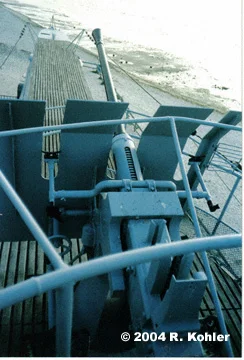
- Replacement of the four-barreled 2 cm “Vierling” anti-aircraft gun with a single 37 mm quick-firing gun on the aft winter garden. The Vierling often failed to work properly, and its bulk could make the boat roll side to side in even moderate seas.
- Addition of a retractable Deschimag I-type schnorkel mast for submerged operation of the diesel engines. A fixed “Bali I” basket antenna was affixed to the top and connected to the radar detector.
- Rearrangement of the foredeck, air bottles, and deck rails into the new hourglass-shaped quick-diving hull configuration. The crash-dive gain was only three seconds, but depth keeping while schnorkeling was greatly improved.
- Installation of survival and dinghy containers on the foredeck.
- Conning-tower conversion that removed the armored anti-aircraft shelters from both the port and starboard sides.
Advanced equipment
Detection, radar, and communications systems.
Other improvements and advanced equipment aboard U-869 included:
- The Hagenuk Wanze G2 radar receiver to detect enemy metric radar transmissions.
- The upgrade of the Borkum radar receiver to the Naxos detector, with the Tunis aerial on the tower to detect enemy centimetric radar transmissions.
- The FuMO 61 Hohentwiel 54 cm radar. Its antenna was carried in a housing box on the port side of the conning tower.
- The Kurier “Kurz” short-signal radio system, a microburst wireless telegraphy transmitter.
The men and their boat
A mostly young crew made U-869 their own.
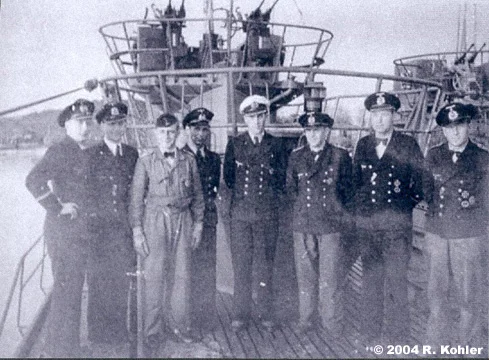
Like many late-war U-boat crews, the men of U-869 came from across Germany and consisted mostly of young new recruits with a handful of experienced men. The average age was 20. Seventeen-year-old Otto Brizius was the youngest, and 34-year-old Erich Tolke was the oldest aboard.
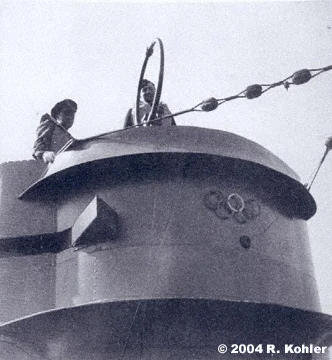
The officers and enlisted men added personal touches to the boat. The five circles of the Olympic Rings were mounted on the front of the conning tower. The rings indicated that commander Kapitänleutnant Helmut Neuerburg had graduated with the Naval Class of 1936, the year the Olympic Games were held in Berlin.
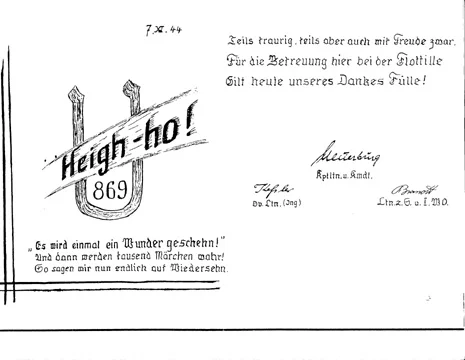

The coat of arms recorded with the U-869 guest-book entry.
Emblems and inscriptions
The “Heigh-Ho” symbol and a hopeful lyric.
Although no other emblem graced U-869’s conning tower, the officers signed the guest books of both the Fourth and Fifth U-boat Flotillas with slightly differing versions of a logo and motto for the boat, as well as a coat of arms.
The crew had reportedly seen Walt Disney’s Snow White and felt that the “Heigh-Ho” symbol over a “U”, or perhaps a horseshoe, suited the boat and its mission. Next to the drawing in the Fourth Flotilla guest book were lyrics from a popular song by Swedish singer Zarah Leander: “I know a miracle will happen and a thousand dreams will come true.” The identity or relevance of the coat of arms is unknown.
Personal names aboard
Three forward torpedo tubes carried names from home.
As in other U-boats, each forward torpedo tube bore the name of a crewman’s wife or sweetheart. Franz Nedel’s fiancée Gisela, Hans-Georg Reber’s girlfriend Hannelore, and Willi Seefeldt’s wife Ellen each had their names painted on the tube doors.
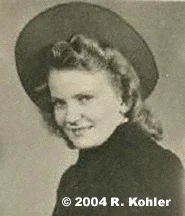
Gisela Engelmann
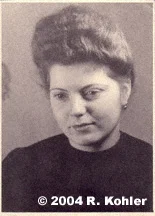
Hannelore Dellenbusch
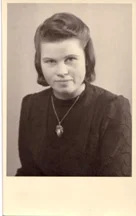
Ellen Seefeldt, wife of Willi Seefeldt
Departure
Ready for battle by late September 1944.
By late September 1944, all modifications and training had been completed and the boat was declared ready for battle. On November 23, 1944, U-869 departed Kiel and arrived in Horten, Norway, on November 27.
The boat spent several days practicing schnorkel technique in the protected fjord, then departed on December 3 and arrived in Kristiansand the following day. After taking on fresh provisions and topping up the fuel bunkers, U-869 left on her maiden war patrol on December 12, 1944.